Saturday, 15 October 2011

Week #2: Chad

Meet Chad
The Republic of Chad is the world's 21st-largest country and is in north central Africa. Chad is named after "Lake Chad" which is the largest wetland in Chad and the second largest in Africa, but is sometimes referred to as the "Dead Heart of Africa" because it is mostly desert. The country is bordered by the Sudan, the Central African Republic, Cameroon, Nigeria, Niger, and Libya. N'Djamena is Chad's capital and largest city.


Weather
The country has three climatic-ecological zones: 
1. Saharan zone - dry and hot
2. Sahelian zone - more rainfall
3. Southern semitropical zone - good rainfall of up to 48 inches per year

Language
Wikipedia states that, "Chad has two official languages, French and literary Arabic, and over 120 indigenous languages. A vernacular version of Arabic, Chadian Arabic, is the lingua franca."

The Flag
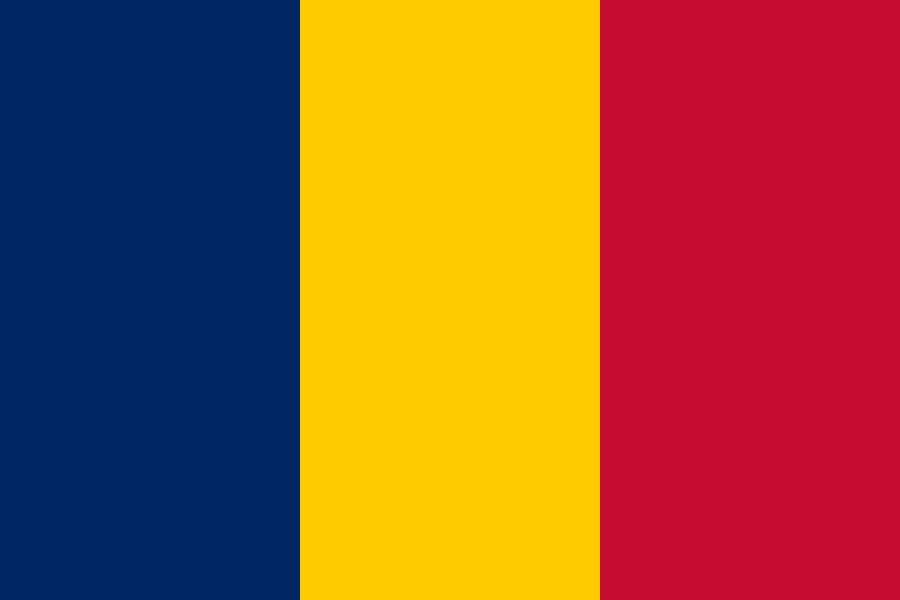
Chad's flag design is an attempt to combine their contrasting history. The blue-gold-red colors used in the flag symbolise sky, hope and water (blue), the sun and the Sahara desert (gold) and unity, prospecrity and national sacrifice/bloodshed for independence (red).


Money
Chad's currency is called the CFA (Communauté Financière Africaine) Franc (XAF). The XAF bills come in 10,000, 5,000, 2,000, 1,000 and 500 denominations, and the coins are in denominations of XAF250, 100, 50, 25, 10, 5 and 1.


Economy
Chad is rich in gold and uranium and stands to benefit from its recently-acquired status as an oil-exporting state. But this nation suffers from inadequate infrastructure and internal conflict - an inheritance from their colonial past.


History & Diversity
Prior to French colonisation, the people of Chad did not live as a political unit. They existed as a conglomerate of kingdoms, chiefdoms and sultanates which varied in size and ethnicity. So, there were frequent wars and raids amongst these states. The various ethnic groups include the Sara (the largest group formed by twelve tribal groups), the Mundang, the Massa, and the Mbum in the south (black African peoples); and the Barma, Fulani, Bagirmi, Tubu, and Maba in the north (Arab peoples). The great diversity and the tradition of slave raiding has left deep scars in the fabric of Chadian society to this day. 


Modern-day Chad has more than 200 distinct ethnic groups, and even though the French colonisers attempted to impose the concept of nationalism, the regional society is the most important to the Chadian people. Chad's population is distributed in a fashion similar to Sudan. The north is inhabited by an Islamic (and partly Arabic-speaking) population while the south has Christians and traditional religious people. The population (2009 estimate) is 10,329,208.

Society
According to World Travel Guide, "Chadians are a relaxed and friendly people, but respect for traditional beliefs and customs is expected. Dress is informal, but conservative in respect of Muslim laws. There is strict segregation of women in the Muslim areas. It is customary to shake hands. The left hand should never be used for offering or accepting food, nor should the sole of the foot be exposed in the presence of a Muslim. Identification should be carried at all times; failure to do so may result in detention by police."

Food
Chadian food is claimed to be a 'must have'. The soft, doughy bread on the rim of the tray is "qissar." The meat dip in the bowl is "mula sharmoot." The dish is eaten by tearing off a piece of the bread and dipping it in the meat sauce. Delicious! Remember, when eating with Muslims, use only your right hand. 

In the capital there is a fair selection of restaurants serving mainly French and African food. Outside the capital, restaurants tend to be cheap and cheerful and there is an acute shortage of some foods. The national specialty is peanut sauce over rice (often eaten in Southern Chad). The national drinks are Chad's excellent beer, Gala and Karkanji, a drink made from Hibiscus flowers.


Attractions & National Treasures

Despite its lack of infrastructure, Chad has a number of impressive national treasures to share with visitors. Some of the places to see are:
  1. The Place de la Liberation
  2. The Presidential Palace
  3. The National Museum
  4. The Chari River
  5. Hadjer el Hamis or "Elephant Rock"
  6. Zakouma National Park
  7. Lake Chad 
The nation is resourceful and rich in culture, yet continues to suffer the ill-effects of ethnic/religious conflict, colonisation, and slavery. Maybe change is waiting in the future.

Sunday, 2 October 2011

Week #1 Ghana - Music

I remember visiting the home of one of my Ghanaian brothers a few years ago and enjoying a delicious traditional meal, some good 'reasoning' and music. I remember how he played different styles of music and how much I enjoyed the really older, traditional music.


Highlife
According to Wikipedia, "Ghana has many styles of traditional and modern music, due to its multiplicity of ethnic groups and its cosmopolitan geographic position in West Africa. The best known modern genre that originated in Ghana is Highlife" which incorporates elements of swing, jazz, rock, ska and soukous..."


Ofori Amponsah aka All4Real seems to be quite popular in this genre. Museke shares that he sings mostly love songs, started his own record label and has received an MTV Best African radio hit of the year. I find the video for his song "Cinderella" to be quite funny while romantic:


For many, he's considered the best Highlife singers in Ghana and has helped to unearth a number of artistes, including Ofori Amponsah to the Ghanaian music scene. Museke has lauded Daddy Lumba as having "released over 20 albums, religiously producing or making an album of his own every single year. He even released a couple of gospel albums." Daddy Lumba has had an incredible career and his son, "Dangerous" is sung in Twi (Ghana’s most common language) and talks about dangerous girls:


Hiplife
Hiplife is a Ghanaian musical style which fuses highlife and hip hop, and is influenced by Jamaican dancehall and reggae. Stylus Magazine states that "dancing is paramount to hiplife, so the beats tend to be faster than American rap productions." So, you should get your groove on with these.


RnM is a girl group that came to fame after winning the Vodafone ‘Icons: Divas Edition’ reality TV show. Their first single, ‘Let Your Hair Down’ has an authentic sounding R&B flavour and the video is well directed too. The media review in Modern Ghana reveals that Deniece, Stephanie and Natasha want you "to loosen up and have some fun anyway despite their hectic lives and its challenges."


According to Vibe Weekly, "The soulful reggae sound of Blakk Rasta has earned him accolades all across the world from his peers and fans alike including presidents Ellen Johnson of Liberia and America's Barack Obama." I like his song "Miss Right". Check out the lyrics he gives to Ms. Right towards the end of the song. *blushing*:


There is much to enjoy with Ghanaian music! I hope you enjoyed the videos and will check out some more.

Saturday, 1 October 2011

Week # 1: Ghana

Meet Ghana
The Republic of Ghana is named after the medieval Ghana Empire of West Africa. The actual name of the Empire was Wagadugu. Ghana was the title of the kings who ruled the kingdom. Before March 1957 Ghana was called the Gold Coast. The country’s neighbours include Togo, Cote d’Ivoire, Mali and Burkina Faso. The climate in Ghana is tropical. It’s relatively warm along the southeast coast, humid in the southwest and extremely hot and dry in the north. Apart from Gold, Ghana is rich in timber, bauxite, manganese, rubber and industrial diamonds. Ghana is famous for its weavers of Kente cloth; an Asante ceremonial cloth.
The Flag
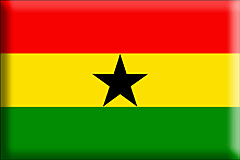
The flag of Ghana consists of the Pan-African colours of red, yellow, and green, in horizontal stripes, with a black five-pointed star in the centre of the gold stripe. The black star was adopted from the flag of the Black Star Line (a shipping line incorporated by Marcus Garvey) as a symbol of African emancipation. The red represents the blood of those who died in the country's struggle for independence, the gold represents the mineral wealth of the country, the green symbolises the country's rich forests and natural wealth.


Language
The official language is English, but there are more than 70 ethnic languages and major dialects are spoken country-wide. 

There are 9 government-sponsored languages and 26 non-government sponsored languages. The government-sponsored languages are supported by the Bureau of Ghana Languages and during the periods when indigenous languages were used in primary education, these were the languages which were used.

Currency
The Ghana Cedi (GH₵) is derived from the Akan word for cowry shell. Cowry shells were once used in Ghana as a form of currency.


Population: 24,223,431 (2010 est.)
Capital City: Accra

Famous Ghanaians
Kofi Atta Annan - UN Secretary General
Kwame Nkrumah - Head of State

Did You Know That
  • Ghana boasts the oldest university in sub-Saharan Africa at Legon in Accra.
  • The first football match in Ghana (Gold Coast) took place under moonlight at the Victoria Park in Cape Coast in 1903 and was organized by a Jamaican.
  • The Lake Volta in Ghana is the one of the largest man-made lakes in the world.
  • Ghana is the world's second-largest producer of Cocoa.
  • The motto of the country is “Freedom and Justice”.