
The Republic of Chad is the world's 21st-largest country and is in north central Africa. Chad is named after "Lake Chad" which is the largest wetland in Chad and the second largest in Africa, but is sometimes referred to as the "Dead Heart of Africa" because it is mostly desert. The country is bordered by the Sudan, the Central African Republic, Cameroon, Nigeria, Niger, and Libya. N'Djamena is Chad's capital and largest city.
Weather
The country has three climatic-ecological zones:
1. Saharan zone - dry and hot
2. Sahelian zone - more rainfall
3. Southern semitropical zone - good rainfall of up to 48 inches per year
Language
Wikipedia states that, "Chad has two official languages, French and literary Arabic, and over 120 indigenous languages. A vernacular version of Arabic, Chadian Arabic, is the lingua franca."
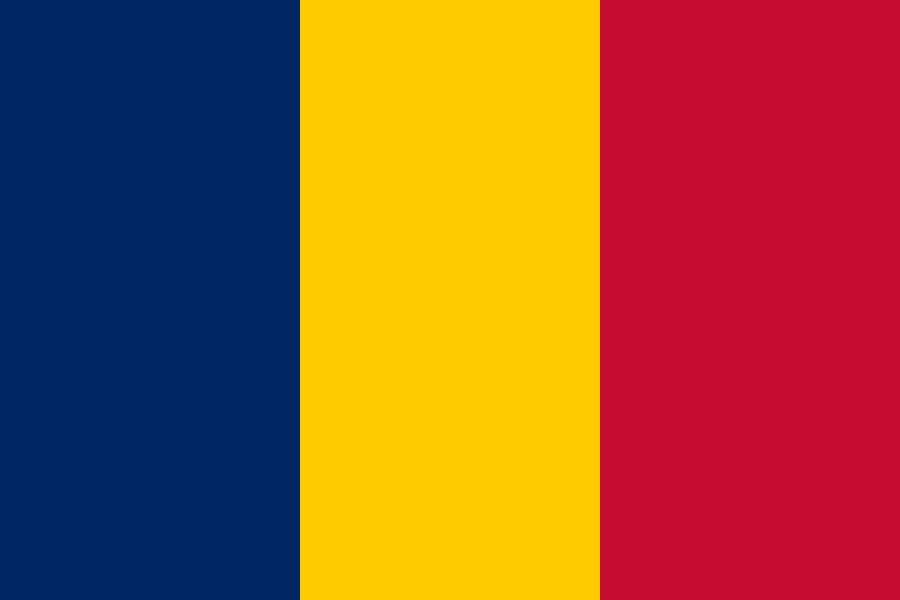
The Flag
Money
Chad's currency is called the CFA (Communauté Financière Africaine) Franc (XAF). The XAF bills come in 10,000, 5,000, 2,000, 1,000 and 500 denominations, and the coins are in denominations of XAF250, 100, 50, 25, 10, 5 and 1.
Economy
Chad is rich in gold and uranium and stands to benefit from its recently-acquired status as an oil-exporting state. But this nation suffers from inadequate infrastructure and internal conflict - an inheritance from their colonial past.
History & Diversity

Modern-day Chad has more than 200 distinct ethnic groups, and even though the French colonisers attempted to impose the concept of nationalism, the regional society is the most important to the Chadian people. Chad's population is distributed in a fashion similar to Sudan. The north is inhabited by an Islamic (and partly Arabic-speaking) population while the south has Christians and traditional religious people. The population (2009 estimate) is 10,329,208.
Society


Chadian food is claimed to be a 'must have'. The soft, doughy bread on the rim of the tray is "qissar." The meat dip in the bowl is "mula sharmoot." The dish is eaten by tearing off a piece of the bread and dipping it in the meat sauce. Delicious! Remember, when eating with Muslims, use only your right hand.
In the capital there is a fair selection of restaurants serving mainly French and African food. Outside the capital, restaurants tend to be cheap and cheerful and there is an acute shortage of some foods. The national specialty is peanut sauce over rice (often eaten in Southern Chad). The national drinks are Chad's excellent beer, Gala and Karkanji, a drink made from Hibiscus flowers.
Attractions & National Treasures
Despite its lack of infrastructure, Chad has a number of impressive national treasures to share with visitors. Some of the places to see are:
- The Place de la Liberation
- The Presidential Palace
- The National Museum
- The Chari River
- Hadjer el Hamis or "Elephant Rock"
- Zakouma National Park
- Lake Chad

No comments:
Post a Comment